
This week, my wife came to me troubled. Half a liter of milk has gone from about KSh54 to between KSh90 and KSh100. “At this rate,” she said, “we may soon stop buying milk.”
Officials blame drought and brokers, and with reason. But a cow cannot eat a forecast. About 500 fodder shrubs can provide a dairy cow with extra feed even when grass fails. If our cows could speak, they would say: we never ran dry; the land did.
Your morning tea grows on a tree we keep pruned to a picker’s waist. Coffee is a tree. The avocado is a tree. So is Muarubaini, or neem, the trusted medicinal tree, and many perfumes begin with wood and resin. Two in three homes in Kenya cook with wood, and forests keep our power dams full. In 2025, tea earned KSh218.8 billion, and tourism about KSh500 billion, much of it resting on forests and savannah that shelter our wildlife. We drink trees, eat trees, cook with trees, light our homes with trees, and forget them. Much of our cost of living is the cost of trees.
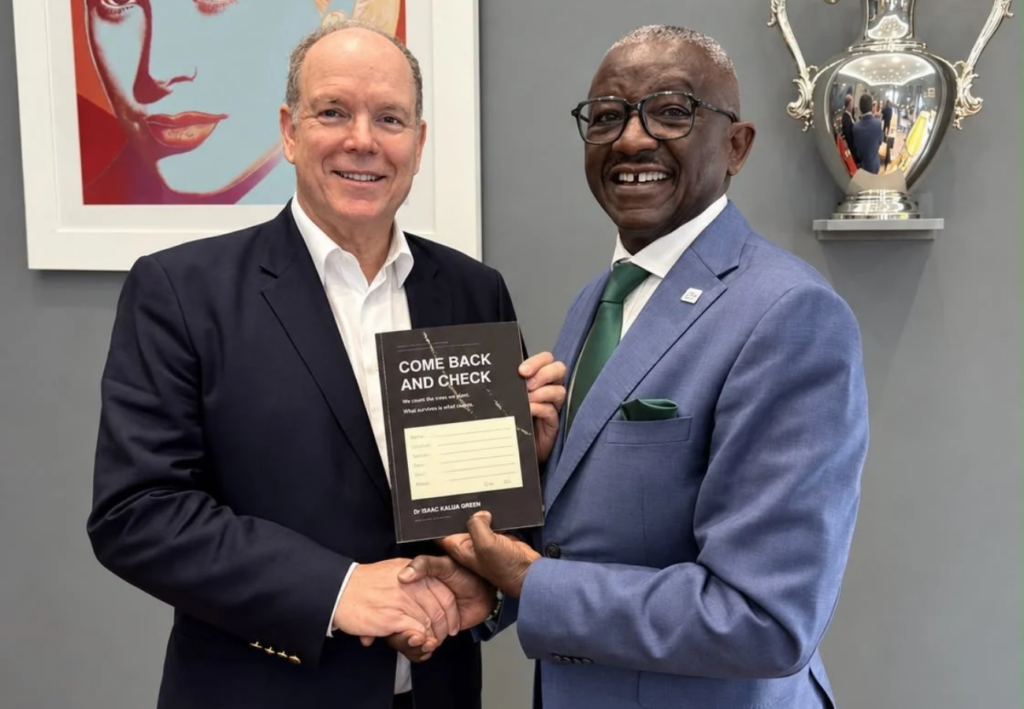
Yet we treat this wealth carelessly. My new book, Come Back and Check, whose first copy His Serene Highness Prince Albert II of Monaco received, carries our age’s confession in its subtitle: every country reports the trees it plants; none reports the ones still alive. Plant Your Age reports 981 million trees. I can walk you to 192 of them.
Nobel laureate Wangari Maathai fought forest grabbers who appeared overnight. Today the greater danger arrives in daylight, with a license, a budget and a groundbreaking ceremony. It fells trees for progress, plants seedlings for a photograph, and rarely comes back to check.
On 14 September, Plant Your Age Day, we invited everyone to plant their age in trees. A tree is time turned into life; a young one survives only if someone keeps faith with it. We do not plant our age to mark a day. We grow it to mark a life.
Hundreds gathered, deliberately in an office, not a field, and thousands followed online worldwide. Offices are where trees are planned and budgeted, and where ownership quietly dies; everyone leaves the meeting, nobody leaves with the tree.
We launched our app there. This week, the Kenya Forest Service unveiled a satellite tool that maps tree cover. Neither alone is the answer. A satellite can see a canopy but cannot water a tree. Only ownership keeps a tree alive, and ownership begins with a price.
Seedlings must never be free. What costs nothing is mourned by no one. In 2005, my wife, Susan, and I raised and sold 900,000 seedlings for KSh27 million. Every buyer had paid for those trees, so every buyer had a reason to return and check.
Think of a tree you planted. Where is it today? Count the trees you inherited: the sacred Mkuyu at the school gate, the baobab behind our mabuyu, and your grandfather’s mango. Checking means guarding what we found, not only what we planted. Life asks the same. The friend you stopped calling. The child whose dream you stopped asking about. The parent still awaiting your visit.
Trees are silent. They are not thoughtless. If a tree could speak, it would say, in my green language, to speak gently: I am the thinking tree. I shaded your school, fed your cow, cooked your supper, paid your fees. I never sent you a bill. You gave me a hole and a photograph, when all I needed was a second visit.
Let dairy cooperatives count fodder shrubs as carefully as they count milk. Let counties pay for trees that survive, not for seedlings handed out. Let every home, school, and church protect the trees standing on its land. And let each of us buy a seedling, name it, and come back to check .Think Green, Act Green.